Our verdict
The Safe 7 earns its place at the top of Trezor's range for anyone who signs transactions from a phone: the 2.5-inch touchscreen, encrypted Bluetooth and Qi2 charging genuinely change how the device is used day to day. What it does not do is prove a security advantage over the $169 Safe 5, and a disclosed laser fault-injection weakness in the auditable TROPIC01 chip means the newest part is also the newest attack surface. Buyers who sign mostly from a desk should save $80 and buy the Safe 5 instead.
Specs
- Price
- $249
- Screen
- 2.5" color touchscreen, 520x380, Gorilla Glass 3
- Secure elements
- TROPIC01 (auditable) + EAL6+ Optiga
- Battery
- LiFePO4 3.2V, 330mAh, Qi2 wireless charging
- Connectivity
- Bluetooth 5.0+ (encrypted via THP) plus USB-C
- Body rating
- IP67, aluminium housing, physical Bluetooth kill switch
- Quantum-ready feature
- ML-DSA-44 signed device certificate (NIST 2024 standard)
- Coin support
- 1000s of coins and tokens; Monero needs a separate app
- Comparable Trezor models
- Safe 5 ($169), Safe 3 ($79)
We set up a Safe 7 next to our long-serving Safe 5, moved a small test balance onto the new device, paired it over Bluetooth with an iPhone, and signed the same transaction twice: once wirelessly, once over USB-C on a desktop. Trezor calls this its most complete wallet yet, and after a week of carrying it around, the touchscreen and the phone pairing are the parts that actually changed our routine.
What $249 buys over the Safe 5
The headline upgrade is the screen: a 2.5-inch color touchscreen at 520x380 pixels and 700 nits, protected by Gorilla Glass 3, which Trezor measures as 62% larger than the Safe 5's 1.54-inch panel. Bluetooth 5.0+ pairs with iOS, Android, Windows, macOS and Linux, with every command encrypted through what Trezor calls the Trezor Host Protocol, and a physical switch lets an owner cut the radio entirely. A LiFePO4 battery replaces the standard lithium cell used elsewhere, rated for four times the charge cycles, and it tops up on any Qi2 charging pad instead of a cable.
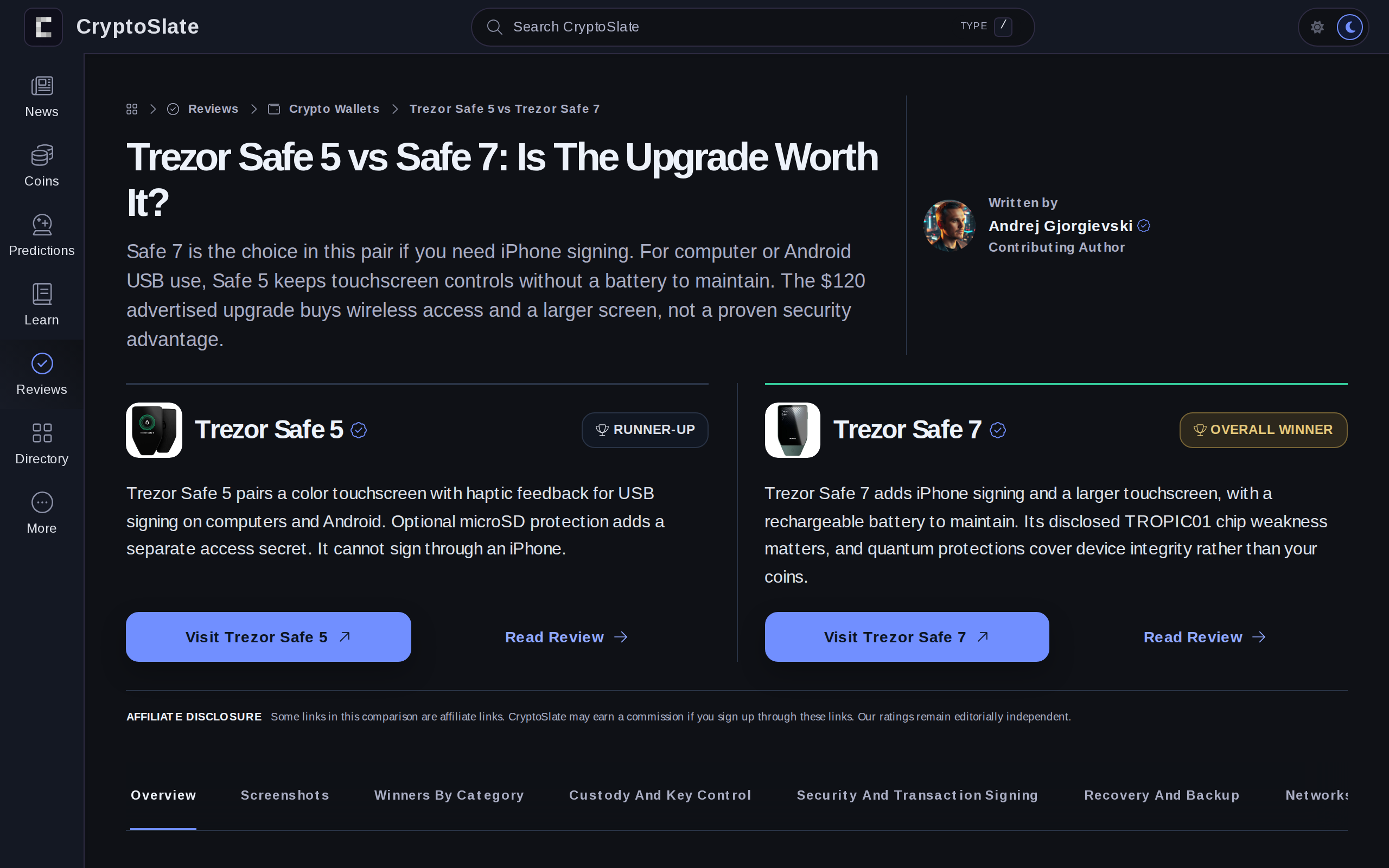
CryptoSlate's own comparison put it plainly: the $120 gap between the two devices (Trezor lists the Safe 5 at $169) buys wireless access and a bigger display, not a proven security advantage. We agree with that framing after using both side by side. The Safe 5 still signs from a desktop or Android phone over USB without a battery to charge or a radio to worry about, and for anyone who never signs from an iPhone, that is a real reason to save the $80.
The auditable chip, and the flaw disclosed alongside it
Trezor's pitch for the Safe 7 centers on the TROPIC01 chip, described as the first auditable Secure Element in a consumer hardware wallet, paired with a separate EAL6+ certified Optiga chip and an STM32U5 microcontroller for three independent layers guarding the PIN and seed.
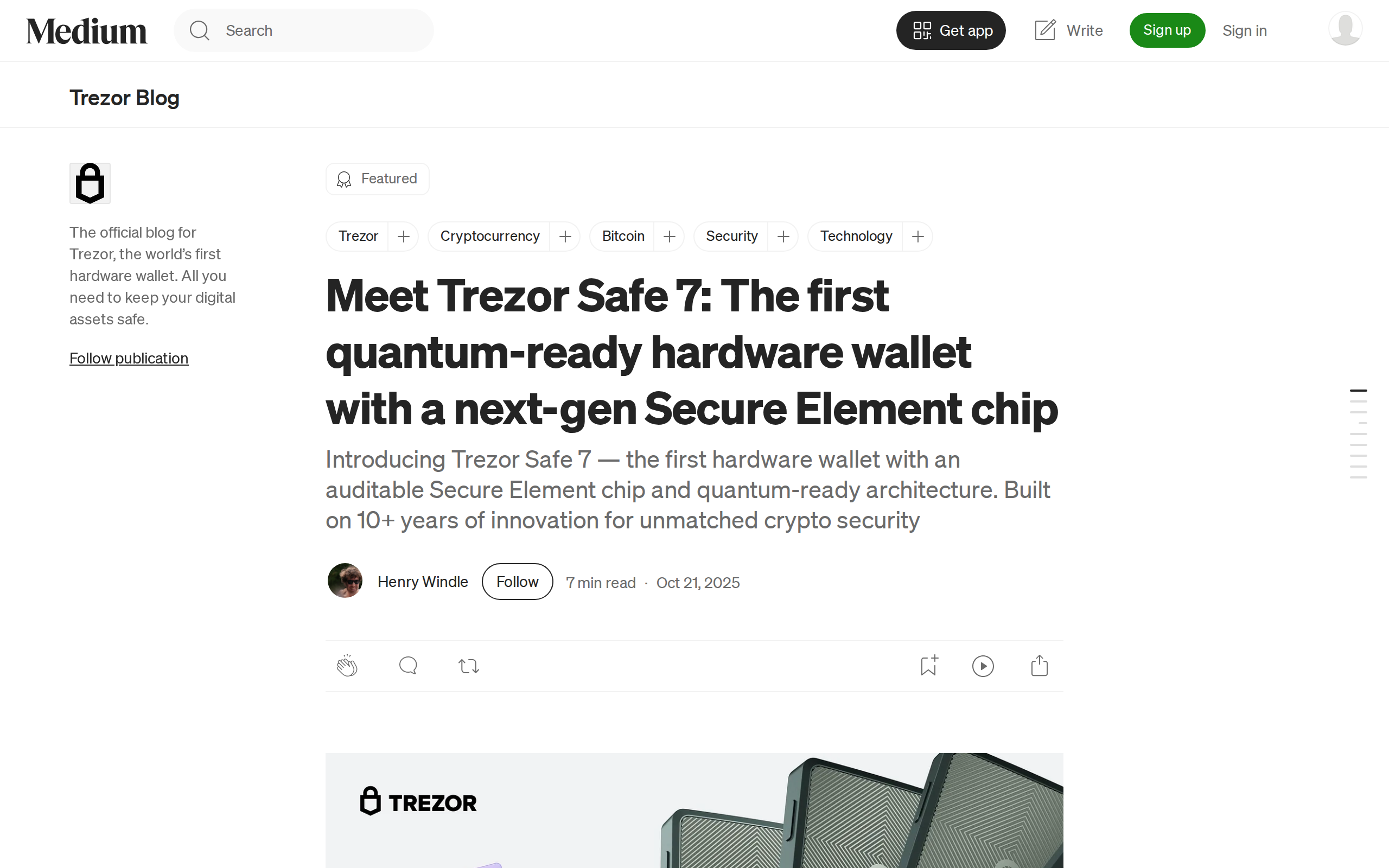
Auditable is not the same as flawless. Independent testing disclosed a laser fault-injection vulnerability in the TROPIC01 chip itself, the kind of attack that requires physically opening the device under a microscope rather than anything reachable over Bluetooth or USB. Trezor's position is that the wallet is not fully exposed through this weakness alone, since the second Optiga element still stands between an attacker and the seed. We take that at face value, but it means the newest component in Trezor's lineup is also the one with a disclosed physical attack path on record before its first year is out.
A battery that cannot be swapped, and other rough edges
The LiFePO4 cell is not user-replaceable, which turns a device with a potential wear part into one with a guaranteed one, even if Trezor's four-times cycle-life claim holds up. Two smaller gaps stood out during setup: the Safe 7 has no QR-only signing workflow for anyone who wants to keep both Bluetooth and USB switched off permanently, and Monero support requires a separate companion app rather than living inside Trezor Suite. iPhone owners should also know that USB-C on that device only charges the wallet; every iOS signature has to go over Bluetooth.
Quantum-ready, with a specific and limited meaning
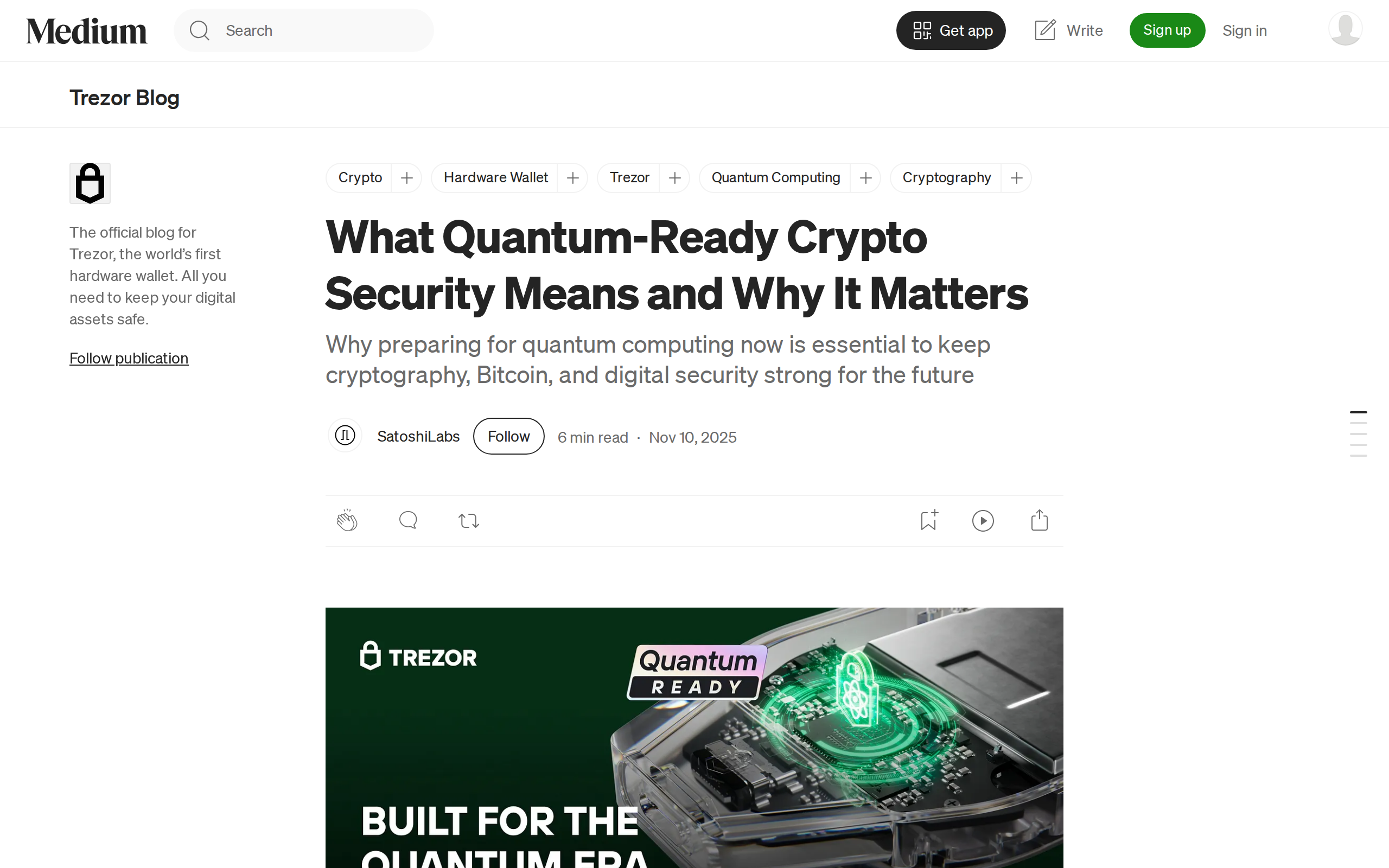
Every Safe 7 ships with a device certificate signed using ML-DSA-44, an algorithm NIST standardized in 2024, and checks its own bootloader against that signature on every startup to confirm the firmware has not been tampered with. That protects the device's own integrity against a future quantum computer forging its firmware. It does not, on its own, make the Bitcoin or Ethereum held on the device quantum-resistant, since that depends on those networks adopting post-quantum signature schemes of their own, something neither has done yet. Trezor is explicit that this is preparation, not a guarantee extended to the coins themselves.
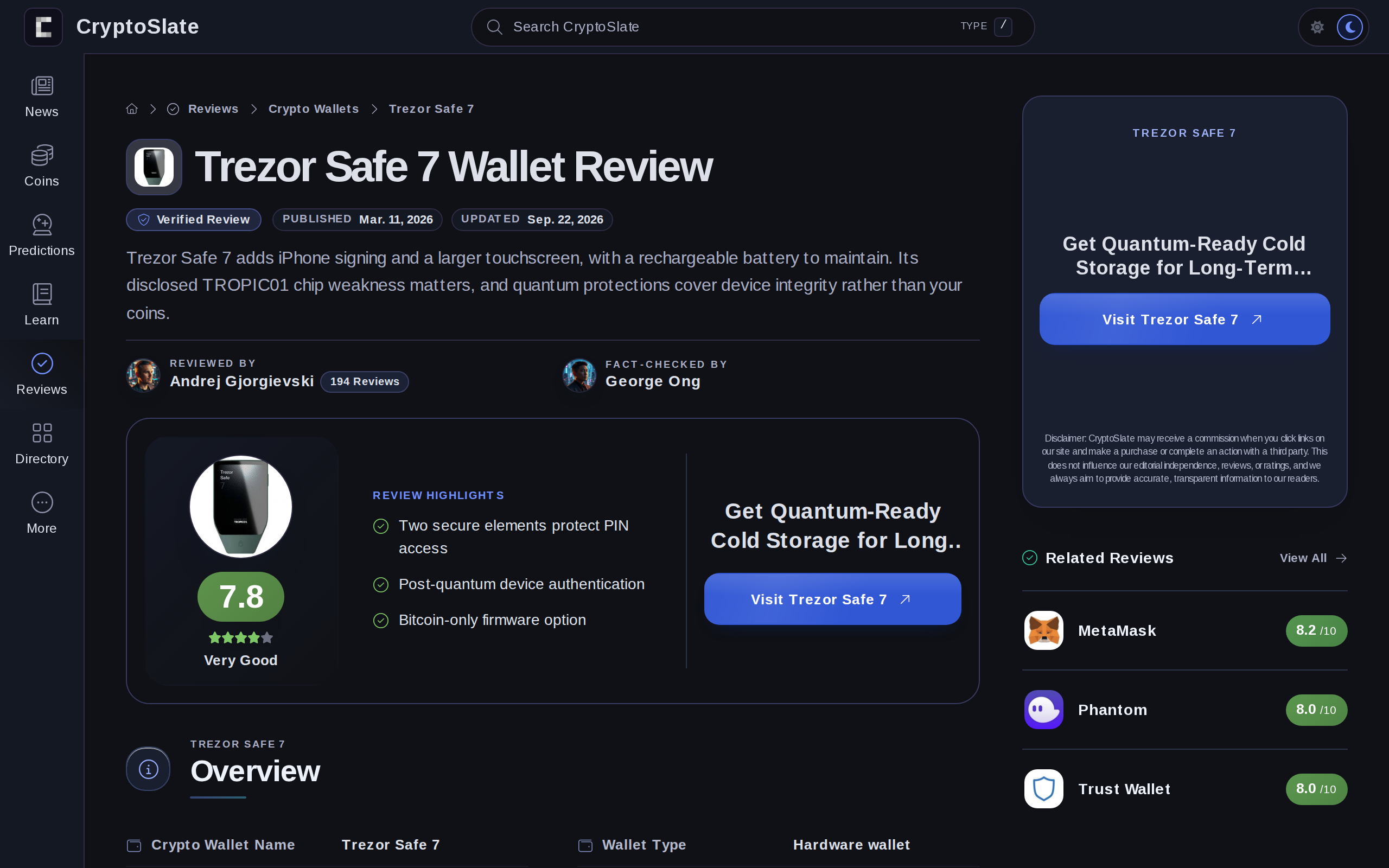
CryptoSlate landed on a 7.8 out of 10 after its own testing, close to where we ended up, and it called out the same PIN protection and quantum device authentication we found while reading the specs sheet. Independent agreement on the strong points matters more to us than any single lab's number, since it means the marketing claims survive a second set of hands.
Our verdict
Buy the Safe 7 if phone-based signing is part of your routine and you want the largest screen Trezor makes; the Bluetooth implementation and the kill switch are executed carefully enough that we trust them for daily use. Skip it and buy the Safe 5 if your signing happens at a desk, since the price difference buys convenience rather than a security upgrade you can point to, and a non-replaceable battery is one more part that can eventually fail.
Pros and cons
Pros
- 2.5-inch, 520x380 touchscreen at 700 nits, 62 percent larger than the Safe 5's display
- Encrypted Bluetooth 5.0+ with a physical kill switch and IP67 aluminium body
- LiFePO4 battery rated for 4x the charge cycles of standard lithium, plus Qi2 wireless charging
- Dual secure elements: the auditable TROPIC01 chip alongside an EAL6+ certified Optiga chip
Cons
- $249 versus $169 for the Safe 5, a premium CryptoSlate priced at $120 for wireless access and a bigger screen alone
- Disclosed laser fault-injection vulnerability in the TROPIC01 chip, though Trezor says the wallet is not fully exposed by it alone
- Battery is not user-replaceable, unlike a device with no battery to fail at all
- iPhone owners can only sign over Bluetooth; USB-C charges the phone but cannot sign there
Tested and written by The Ordertide Test Desk. Published , updated . This review is not financial advice. How we review.