Our verdict
OKX's pitch, one login covering a licensed spot exchange and a non-custodial Web3 wallet, held up in our testing: the regular 0.08 percent maker fee undercuts several rivals, and the wallet's swap router genuinely compares 400-plus DEXs across more than 30 networks. That combination came from a $504 million settlement after a guilty plea to running an unlicensed money transmitting business, and the exchange still will not open accounts in New York, Texas or several other jurisdictions. Traders comfortable with that history get a capable, cheap combined platform.
Specs
- Regular user spot maker/taker
- 0.08% / 0.10%
- VIP 6 maker fee
- 0.00%
- OKB fee discount
- ~25% (2,000+ OKB holders)
- 24h withdrawal limit, regular user
- $10,000,000
- Web3 DEX coverage
- 400+ DEXs, 30+ networks
- DEX interface fee range
- 0% to 0.5% by token pair
- US compliance settlement
- $504M+ (Feb 2025 guilty plea)
- US restricted states
- New York, Texas, Nevada
We funded an OKX spot account with a small stake, bought BTC against USDT at the posted regular fee, then opened the same account's Web3 wallet tab and routed a swap through its DEX aggregator without creating a second login. Binance still draws the bigger crowd, but OKX is the exchange most often named as the one-account alternative, and our week with it showed exactly why alongside the reason to read the fine print first.
What the regular fee tier actually costs
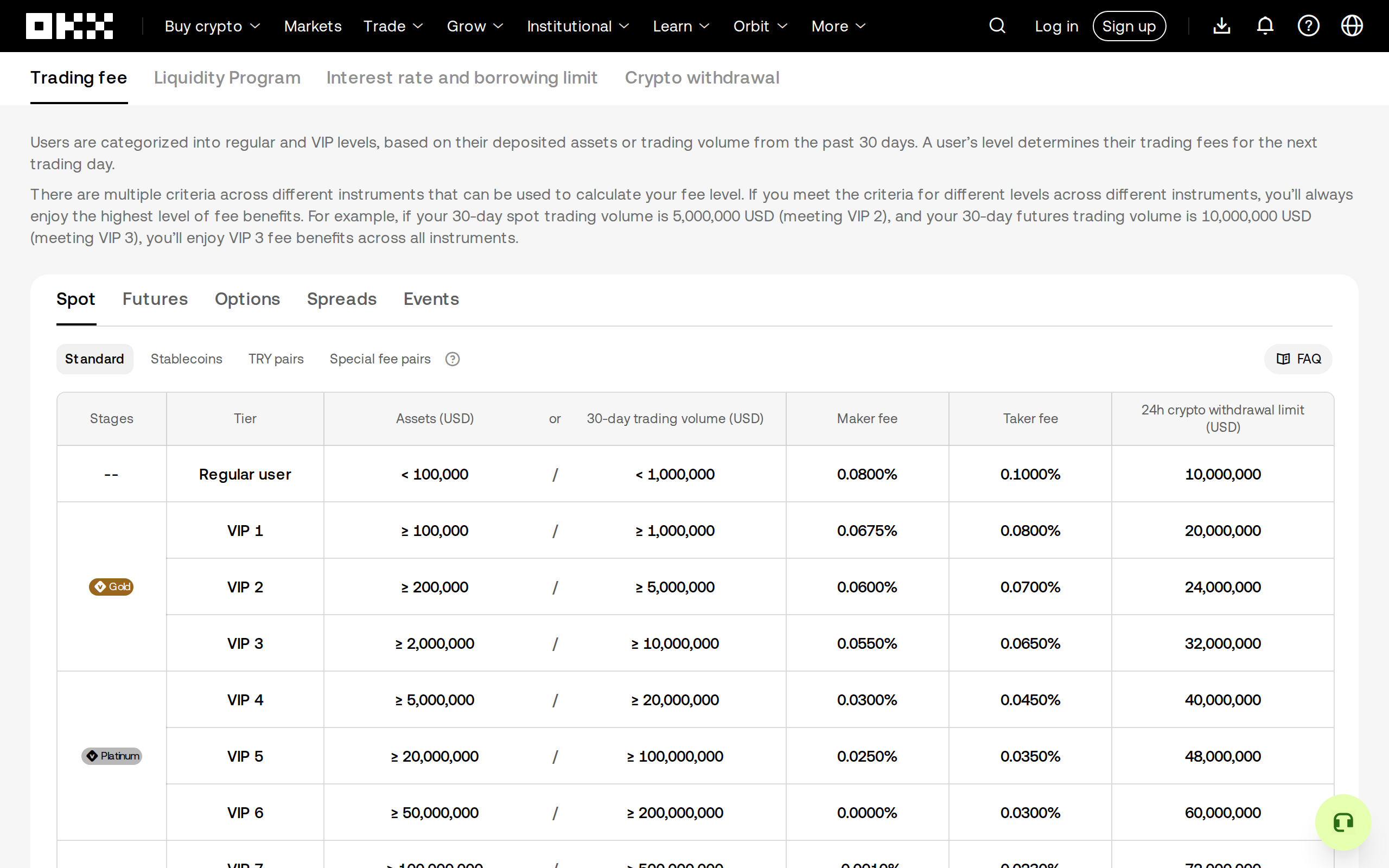
OKX prices spot trading on a maker-taker schedule that starts at 0.08% maker and 0.10% taker for any account under $100,000 in assets or $1,000,000 in 30-day volume. That undercuts Kraken's 0.40%/0.80% starting tier by a wide margin, though it sits close to what other large exchanges quote a new account. The tiers step down fast: VIP 1 needs only $100,000 in assets or $1,000,000 in volume to reach 0.0675%/0.08%, and VIP 6 drops the maker side to 0.00%. Holding at least 2,000 OKB, the exchange's own token, and paying fees in it trims roughly another 25% off whatever tier a trader has already earned.
One login, two very different products
The part that actually differentiates OKX is what happens after the trade. The same account credentials open OKX Wallet, a non-custodial Web3 wallet that routes token swaps across more than 400 decentralized exchanges and over 30 networks through what OKX calls X Routing, aiming to fill an order at the best available price rather than the first one found.
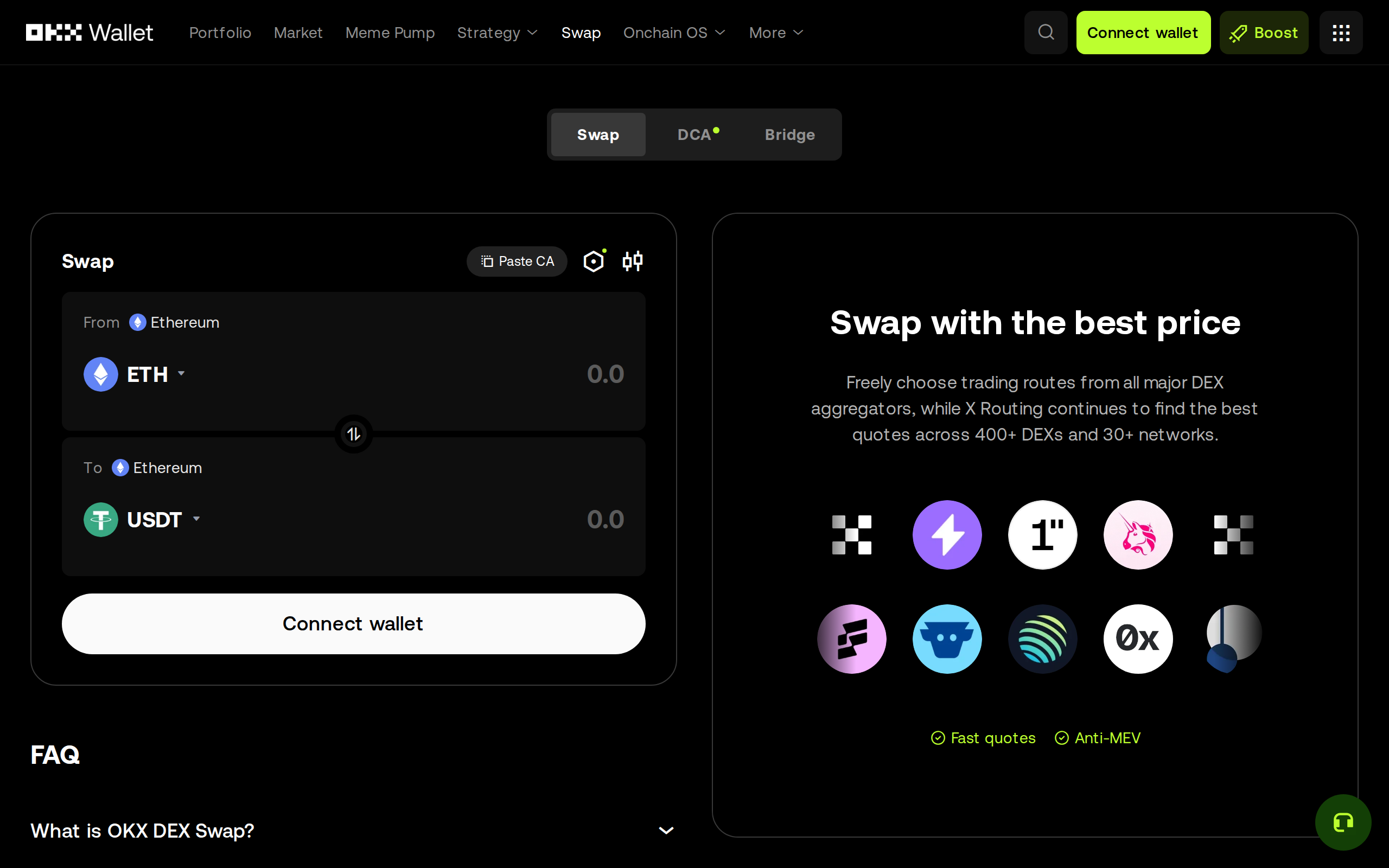
That router charges its own interface fee, ranging from 0% to 0.5% depending on the token pair, layered on top of whatever gas the destination network charges. It is a fair price for comparing hundreds of pools at once, but it is not free, and a trader moving between the custodial exchange and the self-custody wallet should expect two separate fee lines rather than one combined rate.
The trading screen itself
Day to day, the spot terminal reads like most professional exchange interfaces: a candlestick chart with configurable moving averages, a live order book, and buy and sell panels side by side. We placed a limit order against the BTC/USDT book and watched it queue in real time next to bids and asks a cent apart.
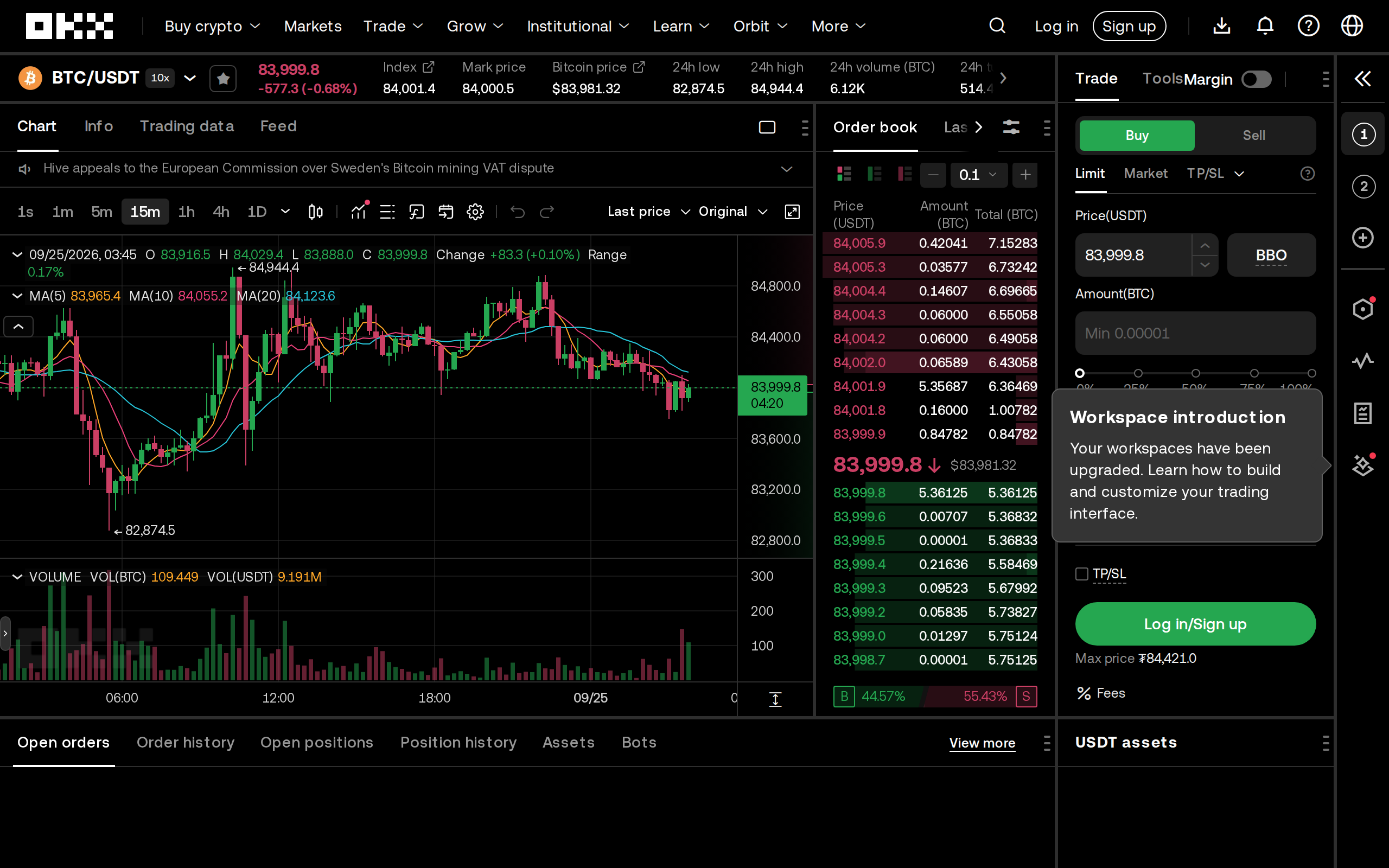
None of that is unusual among the larger exchanges, and traders coming from Kraken Pro or Binance will find the layout familiar within minutes. What stood out during our session was how the platform handled a routine software update: a workspace-introduction prompt appeared mid-trade to announce a redesigned interface, and it was still possible to read the live order book and cancel a resting order underneath it. A cosmetic interruption during an active limit order is a minor complaint, but it is the kind of detail that separates an exchange built for daily use from one that has bolted a trading screen onto a marketing site.
The history worth knowing before funding an account
OKX's Seychelles operating entity pleaded guilty in February 2025 to running an unlicensed money transmitting business and paid more than $504 million in penalties, with an external compliance consultant now required through February 2027 under the plea agreement. The US relaunch that followed operates through a separate FinCEN-registered entity, OKX INC., offering spot trading, the wallet and regulated futures since April 2025. That US platform still will not open accounts for residents of New York, Texas or Nevada, and OKX blocks Canada, India, Japan, Iran, North Korea, Syria and all US territories outright, alongside the occupied Ukrainian regions.
We do not treat that history as disqualifying on its own, since several large exchanges carry a regulatory settlement somewhere in their past. What matters to a reader deciding where to hold funds is whether the response looks structural or cosmetic, and a mandated external compliance consultant running through 2027 leans toward structural. Anyone still uneasy with that record has Kraken and other alternatives reviewed elsewhere on this site.
Our verdict
OKX earns a place on this site's list on price and on the genuine convenience of one login covering both a licensed exchange and a capable Web3 wallet. The settlement history is large enough that it belongs in any honest recommendation, not as a disqualifier but as context a trader should weigh the same way they would weigh any exchange's regulatory record before funding an account. Anyone in a blocked state or country has no decision to make either way.
Pros and cons
Pros
- Regular spot fees of 0.08 percent maker and 0.10 percent taker, dropping toward 0.00 percent maker at VIP 6
- Same OKX login covers the exchange and the Web3 Wallet's DEX swap router
- Web3 wallet compares quotes across 400+ DEXs and 30+ networks through its own routing
- US entity is FinCEN-registered, offering regulated spot and futures since April 2025
Cons
- Parent entity pleaded guilty in February 2025 and paid over $504 million for running an unlicensed money transmitting business
- Blocked entirely in Canada, India, Japan and several other countries alongside all US territories
- US platform still excludes New York, Texas and Nevada residents
- DEX swap interface fees run up to 0.5 percent depending on the token pair, on top of network gas
Tested and written by The Ordertide Test Desk. Published , updated . This review is not financial advice. How we review.