Our verdict
Hyperliquid delivers on the core promise: an order book, not an automated market maker, settling every order and liquidation on-chain in about a tenth of a second per block. Fees undercut Binance at the base tier, and depositing means connecting a wallet rather than handing over an ID. The March 2025 JELLY incident showed the limits of that design under attack, when the platform's own vault absorbed a loss before 27 validators voted in two minutes to unwind the trade at a price the exchange chose. That response protected users at the cost of the neutrality the chain advertises, and anyone trading size here should know both halves of that story.
Specs
- Price
- Free access; trading fees apply per trade
- Base maker/taker fee
- 0.015% maker, 0.045% taker on perpetuals
- Consensus
- HyperBFT, roughly 0.07-second block time
- Validators
- 27 delegated proof-of-stake validators
- Unstaking queue
- 7 days
- Native token
- HYPE, used for staking, gas and fee discounts
- Custody
- Non-custodial; users hold funds via connected wallet
- Daily volume
- Regularly exceeds $50 billion across the venue
A perpetuals exchange running entirely on its own blockchain sounds like a pitch, not a product. We funded a Hyperliquid account with USDC, opened a leveraged position, and watched the order book fill in real time before deciding whether the pitch survives contact with an actual trade.
The order book is real, not a marketing slide
Most on-chain trading venues route orders through an automated market maker, a pool of tokens priced by a formula rather than matched against another trader's order. Hyperliquid does neither.
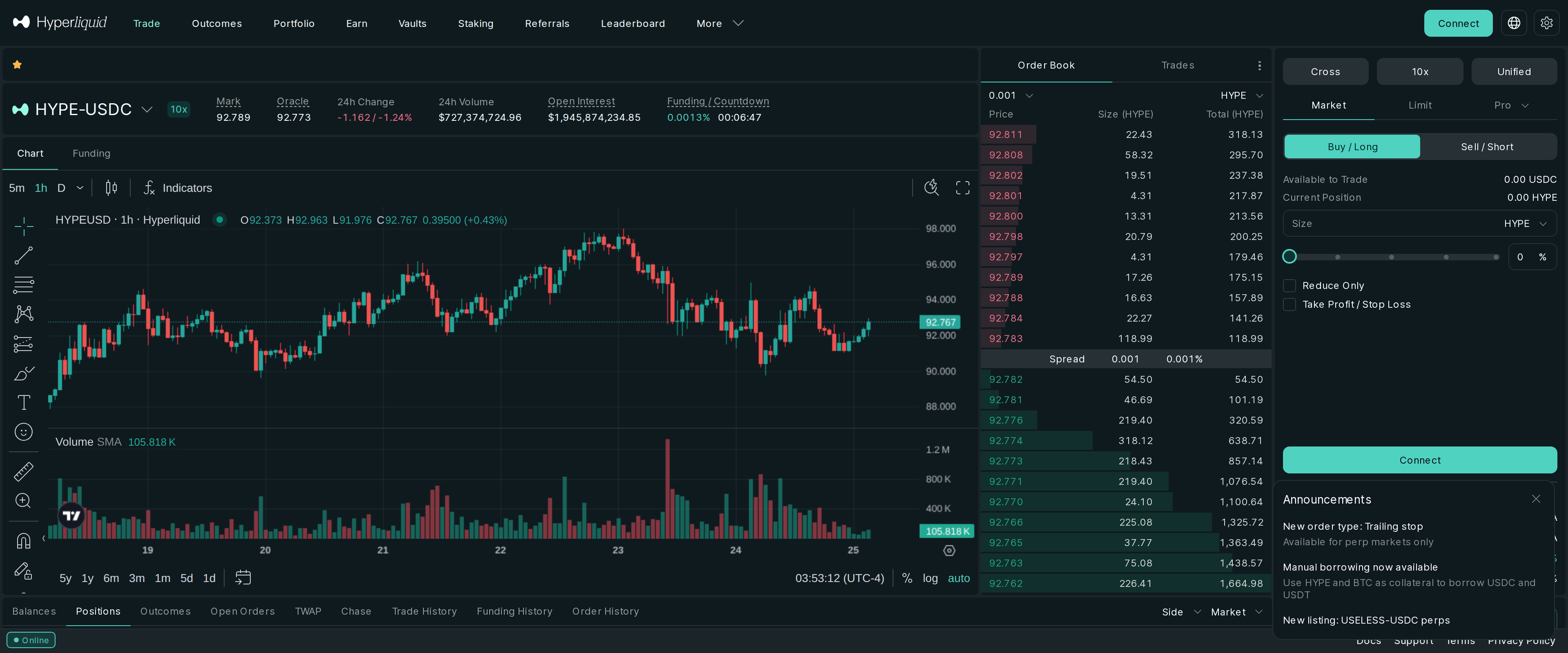
Its own chain runs a proper limit order book, and every order, cancellation and liquidation settles on-chain with what the platform calls one-block finality. HyperBFT, the consensus mechanism behind it, targets a block roughly every 0.07 seconds and a stated capacity of 200,000 transactions per second. We placed and cancelled several limit orders during testing and saw them reflect in the book within a block or two, fast enough that the on-chain part of the pitch stopped feeling theoretical.
What it costs against Binance, in the same units
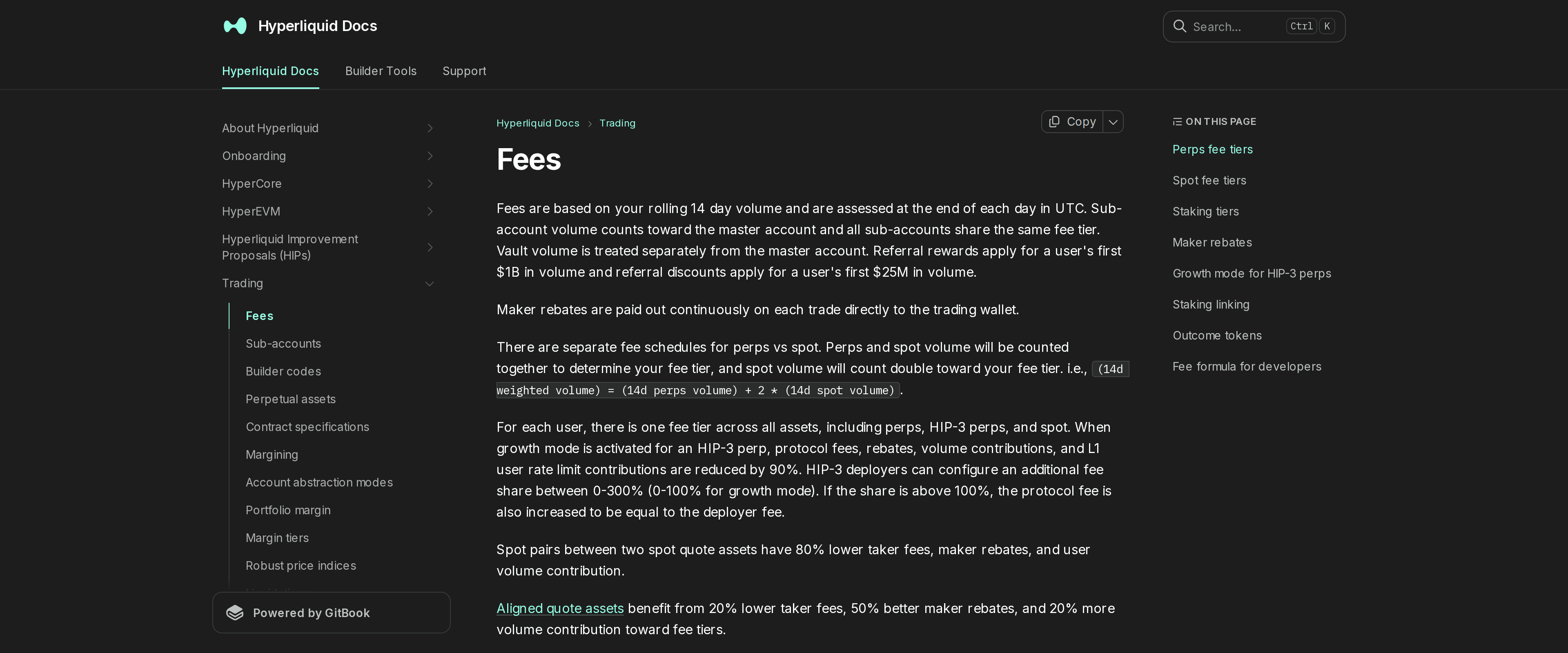
Base-tier fees on Hyperliquid run 0.015% for a maker order and 0.045% for a taker, against Binance Futures' 0.02% and 0.05% at the equivalent tier. That gap looks small until you scale it: on a $500,000 round trip, Hyperliquid runs roughly $450 to Binance's $500 before any discount, and Binance only closes the gap once a trader holds enough BNB to claim its fee rebate. Depositing needs nothing more than a connected wallet and USDC, with no account application or identity document, a genuine difference from every centralized venue we cover.
Liquidity depends heavily on which pair you trade
Aggregate daily volume on Hyperliquid regularly clears $50 billion, and its vaults hold hundreds of millions of dollars in deployed capital.
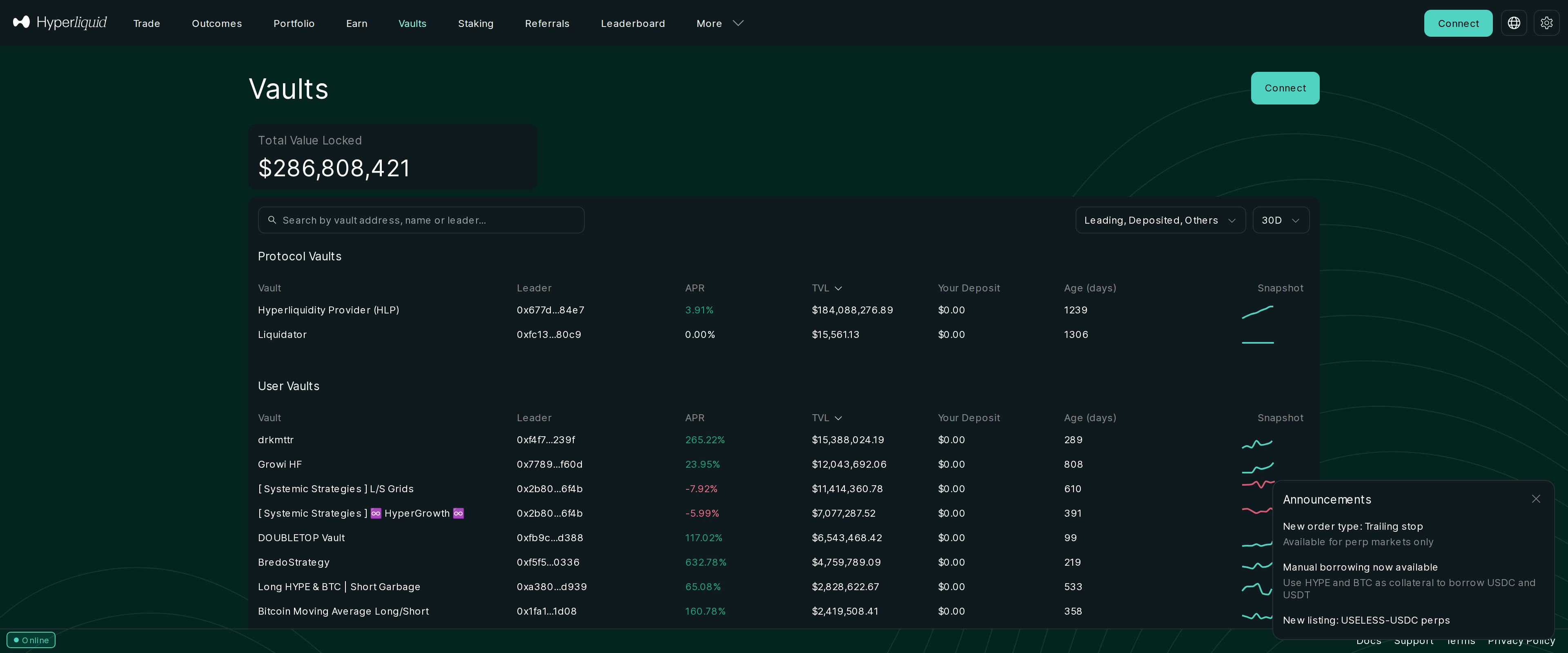
On Bitcoin and the largest perpetuals, spreads have measured tighter than Binance's in independent tests run earlier this year. Move down the list to smaller or newly listed tokens and Binance's deeper bench of altcoin contracts still wins on depth, though a freshly launched perpetual is often only liquid on Hyperliquid in the first place, since centralized venues take longer to list new contracts.
The night the vault took a $12 million hit
No review of Hyperliquid is complete without the JELLY incident, because it is the clearest test yet of what happens when the platform's own design comes under direct attack. In March 2025, a trader opened a large short on a thinly traded memecoin called JELLY, then pumped the token's price until the position could not be closed through the order book alone. Hyperliquid's own vault, the counterparty of last resort in that situation, absorbed the resulting exposure and faced a loss that peaked near $12 to $13 million before the platform's validators stepped in.
How the fix worked, and why it matters
What happened next is the part every trader considering real size should read carefully.
A quorum of the network's 27 validators delisted JELLY and settled every open position at a price far below where the token had traded, cutting the exploit's profit and limiting the vault's loss. The decision took about two minutes to reach consensus, which protected user funds but also showed that an exchange advertising decentralization can still make a unilateral pricing call when its own capital is on the line. Hyperliquid's defenders point out that the alternative, an insolvent vault, would have been worse for everyone; critics point out that 27 validators making that call in two minutes is not meaningfully different from a centralized exchange's risk desk doing the same thing faster.
Verdict: the fastest on-chain venue, with one scar to weigh
Hyperliquid earns the comparison to a centralized exchange that its marketing invites: real order-book execution, fees that beat Binance at the base tier, and settlement fast enough not to feel like a compromise. The JELLY episode does not undo that; it clarifies it. A trader here is betting on a young validator set's judgment under pressure, not just on smart contract code, and that is a different risk than a hack, not a smaller one. Nothing in this review is a recommendation to open a leveraged position; it is a record of what the platform does when things go smoothly and what it did the one time they did not.
Pros and cons
Pros
- Maker and taker fees of 0.015% and 0.045% undercut Binance Futures at the base tier on identical notional size.
- Every order, cancellation and liquidation settles on-chain with one-block finality rather than on a private matching engine.
- No account or identity check is required; trading starts once a wallet connects and USDC is deposited.
- Liquidity on major pairs and freshly listed perpetuals is often deeper than any centralized venue offers for the same new asset.
Cons
- In March 2025 a manipulated JELLY position drove the HLP vault to a loss near $12 million before validators intervened.
- That intervention took a quorum of just 27 validators about two minutes, a level of centralization critics flagged immediately afterward.
- Order book depth on long-tail altcoin contracts still trails Binance, which keeps more liquidity spread across smaller pairs.
- Trading is entirely self-directed with no support desk to call if a position or withdrawal goes wrong.
Tested and written by The Ordertide Test Desk. Published , updated . This review is not financial advice. How we review.