Our verdict
Fomo removes the two things that stop most beginners on-chain: seed phrases and gas tokens. Custody is non-custodial through Privy and trades route via DFlow with MEV protection, both named openly, which is more than most consumer crypto apps disclose. The catch is cost transparency: the trading fee is described as a competitive percentage but never published, so the only way to compare it is to read the confirmation screen on a first small trade.
Specs
- Price
- Free to download and use
- Custody model
- Non-custodial; self-custody wallet powered by Privy
- Order routing
- DFlow, with MEV protection
- Trading fee
- Described as a competitive percentage; rate not published on the public site
- Gas fees
- Included in the quoted total; no separate gas token required
- First buy
- $0 fee on first buy via Apple Pay
- Funding presets
- $25, $50, $100, $250 via Apple Pay
- Authentication
- Apple ID, Google or email verification; no seed phrase
- Platforms
- iOS, Android and web, on one account
- Token filters
- Verified, Trending, Most held, Gainers
- Stated user base
- 2,500,000 traders
- Operator
- FOMO Labs Inc.
Fomo asks a new user to do something that should be impossible: hold their own crypto without ever seeing a seed phrase. You sign in with Apple, Google or email, fund with Apple Pay, and trade across chains without holding a gas token. This review looks at the two questions that decision raises — who actually controls the keys, and what the app charges — using what FOMO Labs publishes about its own stack.
What Fomo is
Fomo is a social-first trading app for memecoins and newly launched tokens, available on iOS, Android and, since 2026, the web. FOMO Labs Inc. states 2,500,000 traders on the platform. The product pitch is explicit about its audience: "a trading app for the rest of us."
That matters for how you read everything below. This is not a general-purpose wallet or a broad exchange — it is a fast on-ramp into the most speculative end of the market, and its design choices follow from that.
The custody model: non-custodial, powered by Privy
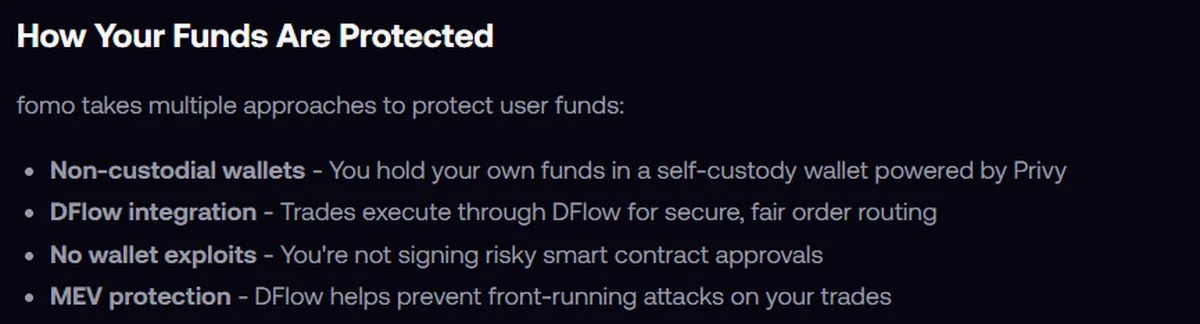
This is the part worth getting right, and Fomo documents it plainly. Its own security page states four things:
Non-custodial wallets — "You hold your own funds in a self-custody wallet powered by Privy."
DFlow integration — "Trades execute through DFlow for secure, fair order routing."
No wallet exploits — "You’re not signing risky smart contract approvals."
MEV protection — "DFlow helps prevent front-running attacks on your trades."
Privy is established embedded-wallet infrastructure, and naming it is the right call — a product that says "self-custody" without saying how is asking for trust it has not earned. Naming DFlow as the routing layer is equally useful, because it tells you where execution quality and MEV protection actually come from.
The practical upshot: there is no seed phrase to lose, and no blanket token approvals sitting on your address waiting to be exploited. Those two facts remove the most common ways individual crypto users get drained.
What self-custody here does and does not mean
Be precise about the trade-off, because "non-custodial" is doing a lot of work in that sentence.
What you gain: Fomo does not hold your funds, so a company failure is not automatically a loss of your balance, and you are not signing the risky approvals that drain wallets.
What you take on: recovery now depends on your sign-in method rather than on twelve words you wrote down. Lose access to the Apple ID or email the wallet is bound to, and you are dependent on that recovery path. Fomo also notes its authentication is resistant to SIM-swap attacks, which is a real advantage over SMS-based logins — but it makes the account itself the thing worth protecting.
For anyone holding a meaningful balance long term, a hardware wallet remains the stronger answer. For someone trading small amounts of volatile tokens from a phone, this model is a sensible compromise. Look at how Fomo sets up a wallet before deciding which of those you are.
Onboarding, gasless trading and Apple Pay
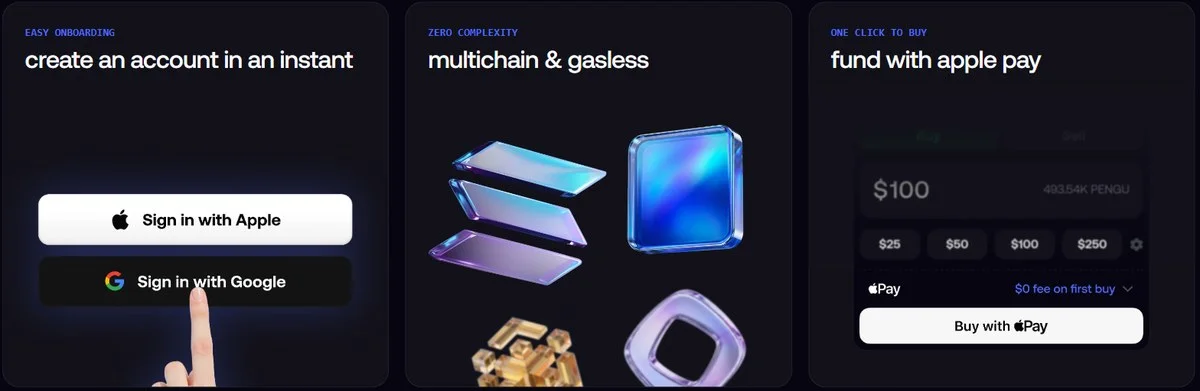
Three product decisions remove most of what normally stops a beginner mid-way through a first on-chain trade:
Sign in with Apple or Google — account creation without a seed-phrase ceremony.
Multichain and gasless — no need to acquire the native gas token of each chain before trading on it.
Apple Pay funding — direct buys with $0 fee on the first buy and presets of $25, $50, $100 and $250.
The gasless piece is the strongest of the three. Gas-token management is the single most common reason a first on-chain trade never completes, and removing it is worth more than most feature announcements.
What the app actually charges
Here we have to be straight with you, because this site cares about fees more than features.
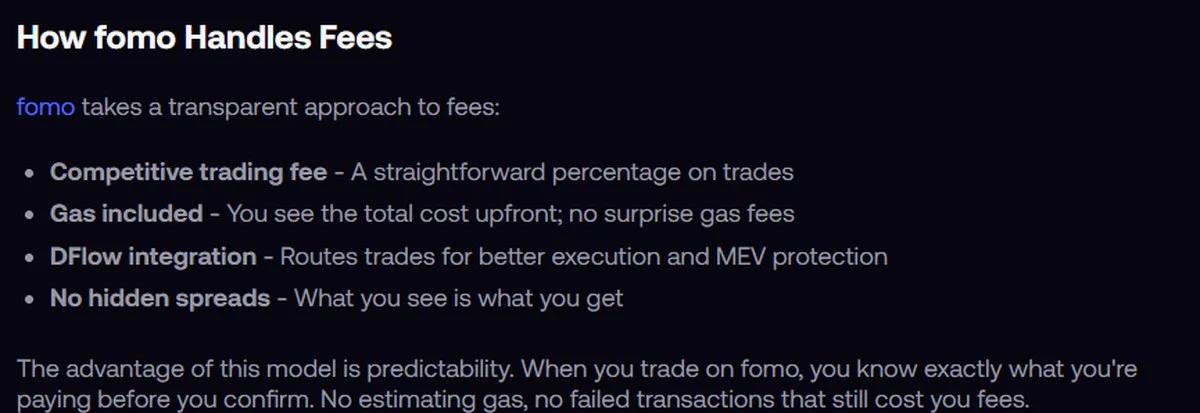
Fomo describes its fee model in four bullets: a "competitive trading fee — a straightforward percentage on trades"; "gas included" so you see the total cost upfront; DFlow routing for execution; and "no hidden spreads." The stated advantage is predictability: "you know exactly what you’re paying before you confirm."
What is not published is the percentage. Across the public site — the marketing pages, the fee explainer and the FAQ library — the trading fee is described but never quantified. The only hard number anywhere is the $0 fee on the first Apple Pay buy.
That is not a scandal; plenty of apps disclose the rate only in the trade confirmation screen, and "gas included, no hidden spread" is a genuinely better model than a low headline rate with gas and slippage stacked on top. But it does mean you cannot compare Fomo on cost before installing it. Check the quoted total on the confirmation screen for a small first trade, and compare that against what the same trade would cost elsewhere, before you size up.
What you are trading
The catalogue is memecoins and newly launched tokens, filtered by Verified, Trending, Most held and Gainers. Each token row shows price, market cap, 24-hour change, volume, liquidity and holder count.
Two of those deserve credit. A Verified filter is a real safety feature on a platform where anything can be listed, and surfacing liquidity next to market cap puts a number experienced traders always check in front of beginners who do not yet know to check it.
Who this suits
Fomo fits someone who wants exposure to new tokens from a phone, values not managing gas and seed phrases, and is trading amounts they can afford to lose entirely. The social layer — leaderboard, feed and alerts — is the discovery mechanism, and it is well built.
It does not suit someone storing long-term holdings, anyone who needs a published fee schedule before committing, or anyone who wants the tax-reporting and fiat-rail infrastructure of a regulated exchange. Compare it with your current setup rather than replacing anything wholesale.
Risk warning
Fomo is not a regulated broker and not a bank. There is no deposit insurance and no statutory compensation scheme. Self-custody means the responsibility for your funds is yours.
Memecoins and newly launched tokens are among the most speculative assets available. They can and frequently do go to zero. A token is on the trending list because it is moving, and movement runs both ways.
The leaderboard shows winners only. It does not show the accounts that lost, and following a profitable trader into a position tells you nothing about their size, their entry or their exit. Treat the feed as discovery, never as a signal to copy.
Trade only with money you can afford to lose, start smaller than the presets suggest, and research every token yourself. Nothing here is personalised financial advice. If the trade-off suits you, you can open a Fomo account free.
How Fomo compares
Against a general-purpose self-custody wallet, Fomo gives up chain breadth and hardware-wallet pairing in exchange for a much better trading and discovery experience on the tokens it lists. Against a centralised exchange, it gives up regulated custody, published fee schedules and fiat rails in exchange for self-custody and access to tokens that never reach a major venue.
It is a specialist tool that is very good at its specialty, and honest about being one. The gap worth closing is the published fee rate — check it on the confirmation screen before you commit anything you would miss.
Pros and cons
Pros
- Non-custodial wallets powered by Privy, with the infrastructure provider named rather than implied.
- Trades route through DFlow, which Fomo credits with fair order routing and MEV protection.
- No seed phrase to lose and no blanket token approvals sitting on your address.
- Authentication via Apple ID, Google or email verification, which Fomo notes is resistant to SIM-swap attacks.
- Multichain and gasless: no native gas token needed before trading on a chain.
- Apple Pay funding with $0 fee on the first buy and $25 to $250 presets.
- Gas included in the quoted price, so the confirmation screen shows a total rather than an estimate.
- Verified token filter, and liquidity shown next to market cap on every token row.
- Web platform and mobile app share one account, so a trade can be opened on a phone and closed on a desktop.
Cons
- The trading fee is described as a competitive percentage but the rate is not published anywhere on the public site.
- Recovery depends on the sign-in account rather than a seed phrase, and there is no hardware-wallet pairing.
- Not a regulated broker: no deposit insurance and no statutory compensation scheme.
- The catalogue is memecoins and newly launched tokens, which are among the most speculative assets available.
Tested and written by The Ordertide Test Desk. Published . This review is not financial advice. How we review.