Our verdict
CoinTracker earns its free tier's popularity honestly: unlimited portfolio tracking, with no card required, is a real product rather than a funnel to the paid tier. The paid side is harder to love, since a $59 Base plan caps out at 100 transactions and Prime jumps to $199 for 1,000, pricing that punishes anyone active across multiple chains. If your year was mostly buying and holding through Coinbase, the tight integration there earns the subscription. If more than a fifth of your activity touched DeFi, budget time to fix miscategorized transactions by hand, a problem CoinTracker has not solved better than its rivals.
Specs
- Free plan
- Unlimited portfolio tracking, no tax report download
- Base plan
- $59/year, up to 100 transactions
- Prime plan
- $199/year, up to 1,000 transactions, tax-loss harvesting
- Ultra plan
- $599/year, up to 10,000 transactions
- Ultra+ plan
- $1,999/year, up to 250,000 transactions
- Exchange/wallet integrations
- 400+ supported
- Smart contract coverage
- 50,000+ contracts, 600+ dapps
- Coinbase relationship
- Listed as an official Coinbase tax partner
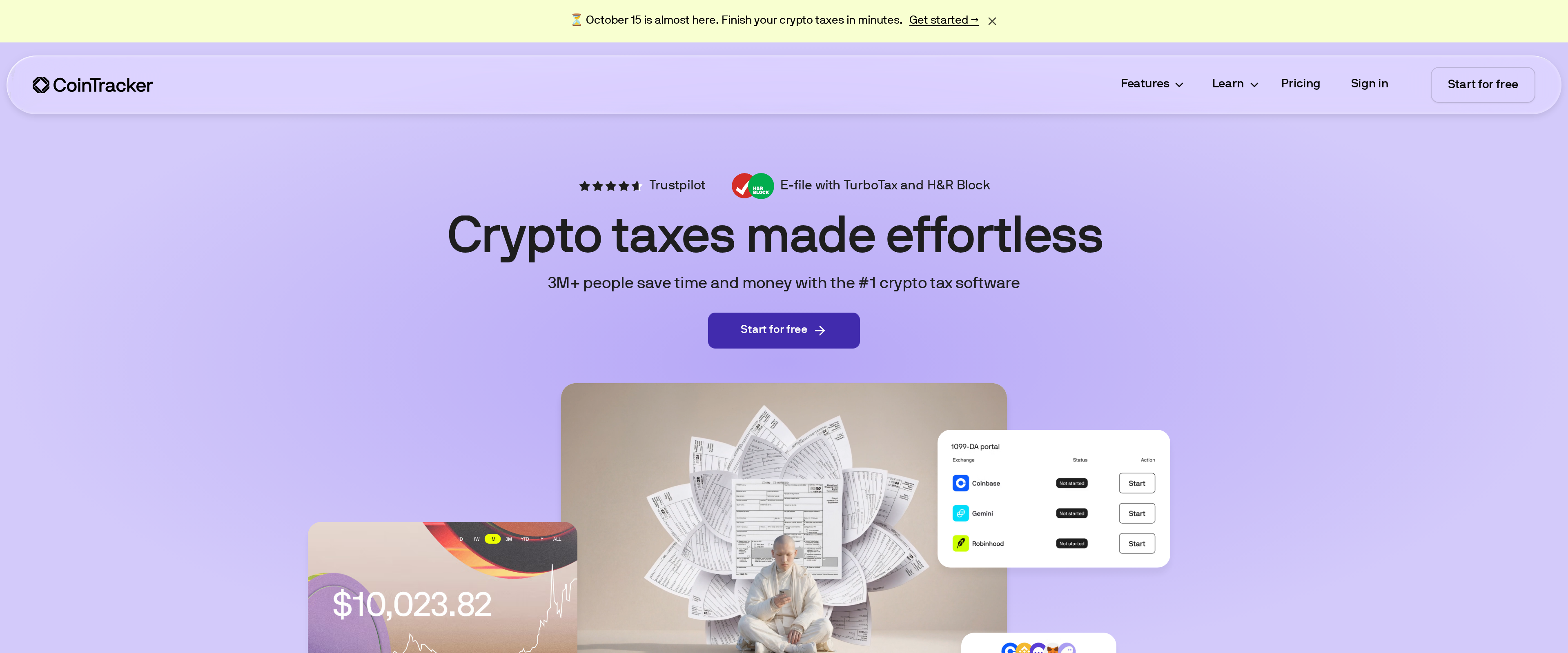
CoinTracker sells itself on a number most tax software avoids leading with: 3 million users, according to its own homepage, more than any tax-only competitor claims. That scale comes partly from a free product people use year-round, not just in April, which is where this review starts before it gets to the part CoinTracker actually charges for.
The free tier is a real portfolio tracker, not a trial
Open CoinTracker without paying anything and you get a working portfolio view across every wallet and exchange you connect, with no transaction limit on the tracking itself.

We connected a Coinbase account, a MetaMask wallet and a Ledger address, and balances synced within a couple of minutes across all three, with 400-plus supported exchanges and wallets behind the connection screen. The catch, and it is the entire business model, is that downloading an actual tax report requires a paid plan even if the transaction count is tiny.
What the paid tiers actually charge
CoinTracker's pricing page lays out four public tiers, and the jump between them is steeper than the tier names suggest.
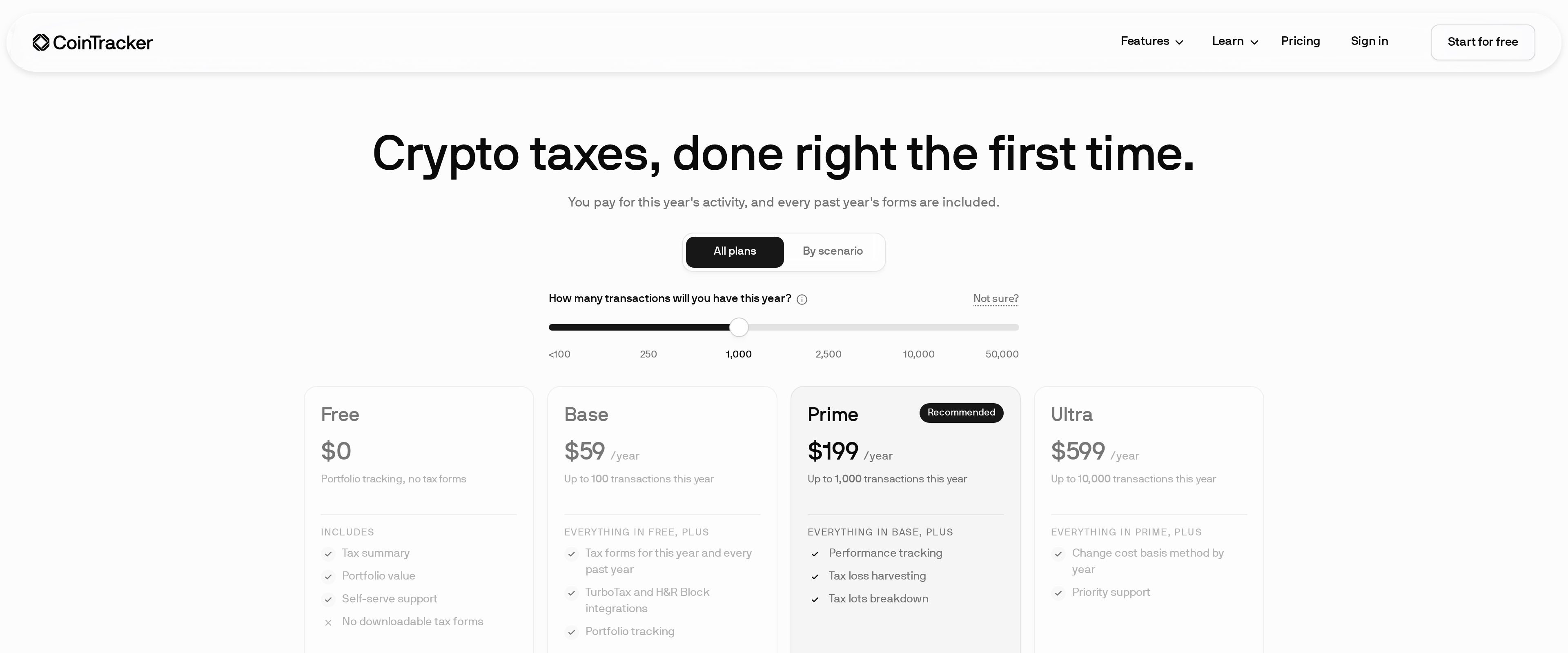
Base costs $59 a year and covers up to 100 transactions, a ceiling an active trader can hit in a single busy week. Prime costs $199 for 1,000 transactions and adds tax-loss harvesting suggestions, a feature that can offset the price for someone sitting on unrealized losses. Ultra and Ultra+ climb to $599 and $1,999 for 10,000 and 250,000 transactions respectively, aimed at high-frequency traders rather than casual investors. Crucially, every transfer between your own wallets counts against the cap the same as a trade does, so moving coins around for security reasons quietly eats into the same budget as actual buying and selling.
How it compares to a tax-only tool on the same data
Koinly, reviewed separately on this site, takes a different approach: its free tier reviews up to 10,000 transactions in full before charging anything, restricting only the final report download. That is a far more generous ceiling than CoinTracker's paid Base tier, and it means a trader deciding between the two tools should count actual transactions first rather than assume either platform's marketing applies to their year. Where CoinTracker pulls ahead is Coinbase integration, since it holds an official partner relationship with the exchange that shows in smoother imports and fewer mismatched transfers than we saw pulling the same account into other tools.
Where the accuracy breaks down
Independent testing comparing CoinTracker against Koinly on identical data found real, if different, mistakes on both sides.

CoinTracker assigned a $0 cost basis to coins that had originated on an exchange which later shut down, a bug that overstates gains until someone manually corrects it. More broadly, users with heavier DeFi activity, above roughly a fifth of total transaction volume, report spending real hours recategorizing transactions the software imported as something other than what they actually were. Neither issue is unique to CoinTracker; every tool in this category struggles with the same category of DeFi transaction that does not map cleanly onto a buy or sell. It matters here because CoinTracker's core appeal, ease of use, is exactly what breaks down once the recategorizing starts.
A support model built for volume, at a price
The Ultra+ and Full Service tiers exist for a different customer than the one reading a pricing page for the first time: someone with tens of thousands of transactions and a dedicated account manager already in mind. Full Service runs $3,499 for up to 300,000 transactions with hands-on reconciliation from CoinTracker's own team, a price that only makes sense once the alternative, a CPA billing hourly to sort through the same mess, gets compared side by side. Most readers of this review will never approach that tier, but its existence says something about who CoinTracker is actually built to serve at the high end: funds and frequent traders, not the investor with a handful of Coinbase trades and an airdrop or two.
Verdict
CoinTracker's free tier is worth using regardless of what tax software eventually produces your return, because a live portfolio view across every wallet costs nothing and works well. The paid tiers are a fair deal only if your transaction count actually fits the plan you buy, since the jump from $59 to $199 for a tenfold increase in allowed transactions punishes anyone who guesses low. Coinbase-centric investors get the smoothest experience here; anyone with significant DeFi activity should expect to do some correcting by hand no matter which tool they choose. Nothing in this review is tax advice, and a licensed preparer should confirm any figures before filing.
Pros and cons
Pros
- The free plan tracks unlimited wallets and exchanges with no transaction cap, useful even for someone who never buys the tax report.
- CoinTracker is an official Coinbase tax partner, and that integration is noticeably smoother than its handling of smaller exchanges.
- The Prime plan at $199/year adds tax-loss harvesting suggestions, a feature not every competitor bundles at a comparable price.
- Support for 50,000-plus smart contracts and 600-plus decentralized apps covers most mainstream DeFi activity without extra setup.
Cons
- Every trade, transfer, staking reward and airdrop counts toward the plan's transaction cap, so the $59 Base plan's 100-transaction limit fills up fast for an active trader.
- Koinly's free tier reviews up to 10,000 transactions before charging for a report; CoinTracker's free tier only tracks a portfolio, not a tax report.
- Cost basis has been assigned as $0 in reported cases involving coins moved from an exchange that later shut down, requiring a manual fix.
- Users with DeFi activity above roughly 20% of total transaction volume report spending hours recategorizing trades the software imported incorrectly.
Tested and written by The Ordertide Test Desk. Published , updated . This review is not financial advice. How we review.